
Quick answer
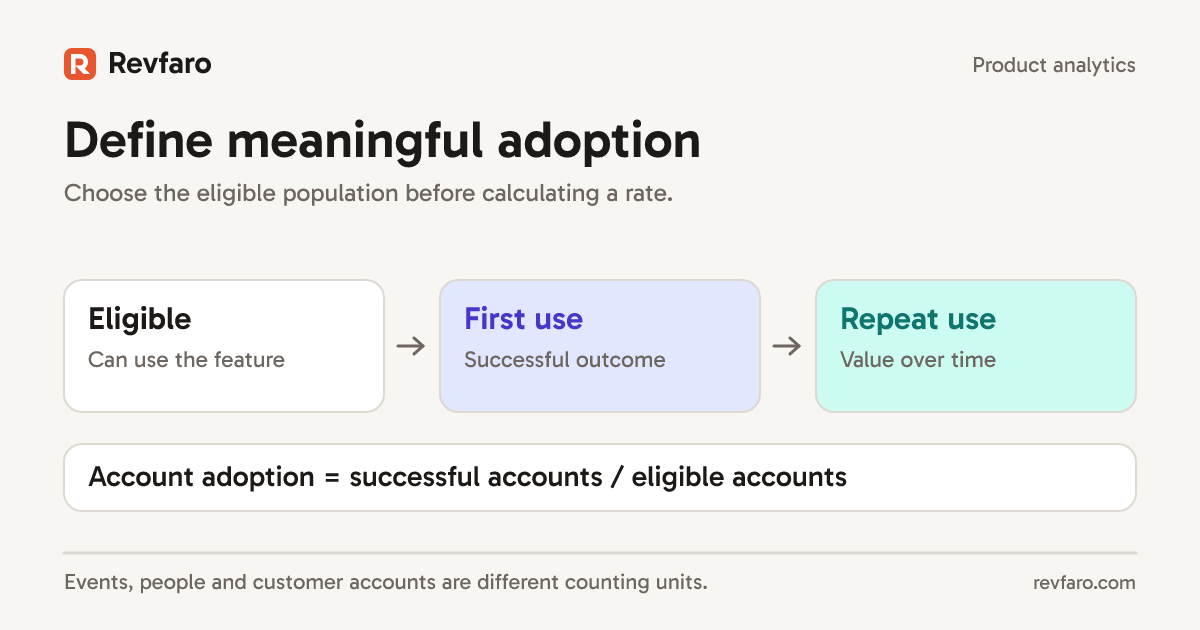
Feature adoption rate measures the share of eligible users or accounts that meaningfully use a feature within a chosen window. It should exclude people who cannot access the feature and distinguish first use from habitual value.
Key takeaways
- Divide adopted accounts by eligible accounts, not event occurrences.
- Record eligibility changes and the successful-use definition.
- Keep account-level adoption calculations in the system that knows account membership.
Define meaningful adoption
Opening a settings tab is not the same as configuring a useful integration. Decide what successful usage means for each feature and specify whether one completed action qualifies or repeated use is needed.
If the feature is available only on premium plans, the denominator should be eligible accounts—not every registered user.
Instrument action and outcome
Track exposure, first use, successful completion, and relevant repeat use as separate events. An event schema should include a safe feature identifier and possibly plan or workspace context, never a secret or unnecessary private payload.
For multi-user workspaces, decide whether adoption is per member or per organization. One person trying a feature does not always mean their whole team adopted it.
Interpret a cohort example
Suppose 200 eligible workspaces see a new reporting feature, 80 try it, and 30 use it again in the following week. First-use adoption is 40%; sustained use among eligible workspaces is 15%. These rates suggest different product questions.
Compare retention of adopters and non-adopters without automatically claiming the feature caused retention.
Turn measurements into decisions
Low discovery with high repeat use suggests better onboarding. High first use with low repeat use suggests unmet expectations or weak recurring utility. Test the experience with real users before changing a product based on one funnel.
Keep the eligibility register beside the event count
Imagine a hypothetical export feature available to 60 customer accounts. Twelve accounts complete an export, but their members produce 45 export events. The account adoption rate is 12 divided by 60, or 20%; dividing 45 events by 60 accounts mixes incompatible units.
Maintain a small worksheet with account identifier, eligibility date, first successful export, and a later successful export. If access changes halfway through the observation window, record the change instead of silently treating every account as equally exposed. Decide whether a scheduled export qualifies before looking at the result.
Revfaro can receive an intentionally emitted completion goal and display properties in a visitor's activity. It does not automatically know your application's feature permissions or account membership. Compute the eligible-account denominator from your product records. Use a stable, non-secret user identifier only where appropriate, and keep email addresses and export contents out of event properties.
Related reading
- How to Measure the Impact of a SaaS Product Release
- Product Engagement Metrics for SaaS Beyond DAU and MAU
Frequently asked questions
Should every feature have an adoption KPI?
Track strategically important features; instrumenting trivial UI interactions adds noise.
Is a feature click proof of adoption?
No. Define a completed value action and, when relevant, repeat usage.