
Quick answer
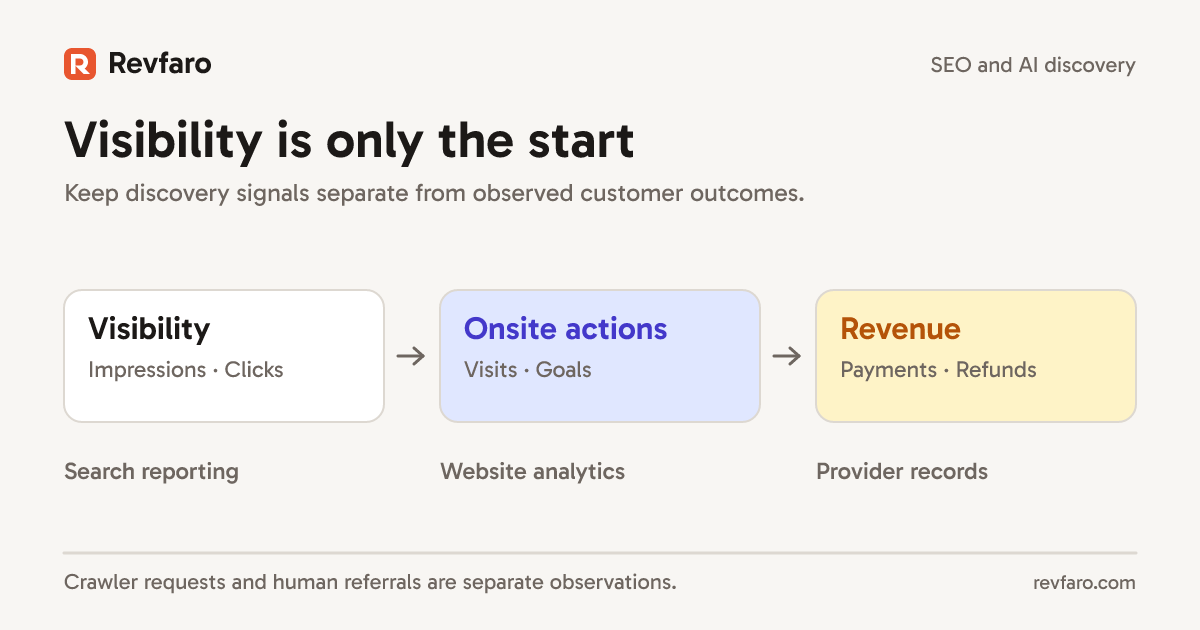
SaaS SEO ROI compares the commercial value associated with organic search against the real cost of content and technical work. Traffic and rankings are useful inputs, but they are not the final business outcome.
Key takeaways
- Use contribution profit and stated costs for ROI, not raw traffic or payment volume.
- Keep unmatched attribution and currency limits visible.
- Recorded payments are not automatically MRR or accounting profit.
Count the full investment
Include research, writing, design, technical SEO, editing, distribution, and maintenance. Some of these costs benefit several months, so declare your allocation policy. Do not claim SEO is free merely because you did not buy clicks.
Separate one-time launch investments from ongoing costs where useful.
Connect organic discovery to value
Use search performance data for impressions and clicks, then website analytics for landing pages, signups, activation, and verified purchases. Define the attribution model and lookback window before applying revenue to a content program.
Unknown or cross-device purchases can remain unmatched. Keep coverage visible rather than inventing a complete ROI.
Work through an illustrative estimate
Suppose a content program costs $2,000 over a period and is credited with $3,000 in measured gross profit contribution under a documented attribution model. Simplified ROI is ($3,000 − $2,000)/$2,000 = 50%. This is not an audited lifetime return; later renewals and content maintenance will change the picture.
Do not compare a mature year-old article with an article published last week as though they had identical opportunities.
Use the result to allocate effort
Identify topic clusters delivering activated users, pages receiving visits but no meaningful next step, and content that needs refresh. Prioritize high-intent buyer problems before chasing high-volume generic terms.
Keep the profit bridge outside the traffic chart
For a hypothetical content review, start with recorded payments associated with organic acquisition, subtract applicable refunds, and separately document the costs required to turn that amount into contribution profit. Payment processing, fulfillment and allocated content costs do not disappear because the analytics dashboard displays revenue. Do not mix a monthly subscription's recurring run-rate with the cash amount of an annual payment.
Revfaro's revenue attribution supplies recorded payment context, not an automatic MRR, accounting-profit or complete SEO ROI calculation. Its currency totals also follow the website currency rules rather than silently converting every foreign-currency payment.
Keep unmatched revenue visible in the reconciliation worksheet. Then compare the effort needed to improve a promising guide with other discovery channels. If you evaluate distribution or analytics tools through IndieTools, include their real cost and measurement limits in the same worksheet instead of treating another tool subscription as free acquisition.
Related reading
- SEO Content Decay: When and How to Refresh SaaS Blog Posts
- Google Search Console vs Web Analytics: Why the Numbers Differ
Frequently asked questions
Can SEO ROI be calculated before revenue exists?
Use clearly labeled leading outcomes such as qualified activation while avoiding unsupported dollar estimates.
Are rankings enough to demonstrate ROI?
No. Rankings are visibility signals, not economic outcomes.