
Quick answer
A SaaS signup funnel is an ordered set of events that shows how eligible prospects progress from interest to an account and initial product value. Track success states, not just button clicks.
Key takeaways
- Use confirmed success events as funnel steps.
- A funnel definition does not create missing historical events.
- Distinguish the selected report period from a per-account completion deadline.
Define the steps in business language
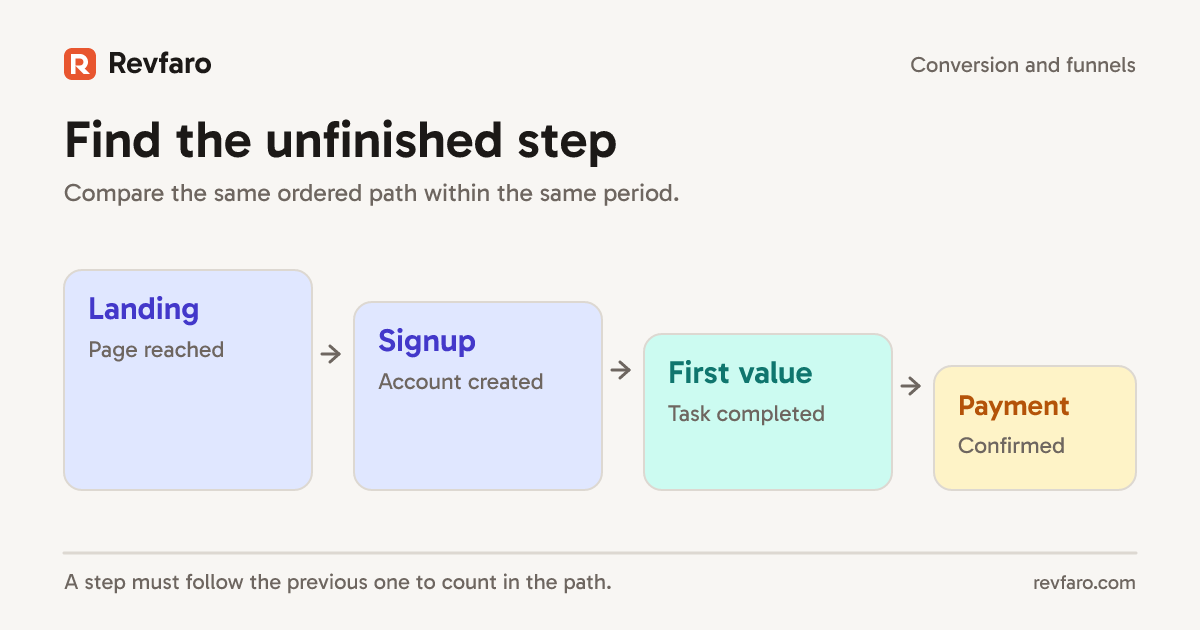
A useful starting funnel might be landing page viewed, signup started, account created, email verified if required, first website or project created, and first-value action completed. Not every product needs six steps. Remove irrelevant friction rather than adding events for presentation.
Define each event's trigger and identity key. Account_created should fire only after a successful server response, not when the user presses Submit.
Decide how to count people
Choose whether your funnel is unique-user-based or session-based, how long participants can take to complete, and whether repeated visits are allowed. An authenticated user may finish onboarding days after registering; a same-session funnel would hide this behavior.
Allow explicit unknown or incomplete states where cross-device links cannot be established.
Find the loss that deserves action
If 1,000 people open signup, 700 create accounts, and 210 reach first value, account creation completion is 70%, while first-value completion among accounts is 30%. Improving initial form conversion alone will not fix the larger onboarding problem.
Segment by device, traffic source, and signup method; verify that the event mapping is correct before changing UX.
Test the entire journey
Run synthetic success, validation-error, duplicate signup, and interrupted-session scenarios. Check SPA route navigation and OAuth redirects. Ensure any return from external authentication does not count the same account twice.
Configure an observable three-step funnel
For an illustrative SaaS, start with a short sequence rather than instrumenting every field:
| Step type | Value | Meaning |
|---|---|---|
| Page | /pricing |
The tracked visitor viewed pricing |
| Goal | signup_completed |
Your application confirmed account creation |
| Goal | first_project_created |
The first meaningful project was created |
In Revfaro, open Funnel, select New funnel, enter the page and exact goal names, then save. The funnel guide documents the supported 2–10 steps. The application must already emit the two success goals; choosing a name in the funnel does not create events retroactively.
Revfaro counts ordered steps by visitor within the dashboard's selected period, including steps across visits. That period is not automatically a separate seven-day deadline for every signup. If you need a fixed per-account activation window, calculate that cohort measure separately and label it accordingly. Test the sequence in an isolated setup before interpreting a missing step as abandonment.
Related reading
- Website Conversion Rate for SaaS: Formulas, Benchmarks, and Context
- SaaS Activation Rate: Define and Measure First Customer Value
Frequently asked questions
Should an email verification step be in the funnel?
Include it if verification materially gates customer progress. Report it separately if verification is optional.
How do I handle users who return the next day?
Define a journey completion window and use legitimate identity continuity so return visits do not vanish from the funnel.