
Quick answer
Between $1,000 and $10,000 MRR, a SaaS founder should strengthen the repeatability of acquisition and retention. Customer value remains central, but cohort evidence, channel cost, and revenue movement become more actionable.
Key takeaways
- Reconcile opening and closing recurring value with explicit movements.
- Do not confuse a refund with a second recurring-value loss.
- Treat cohort economics as separate calculations with maturity limits.
Keep the activation definition stable
Track signup-to-first-value rate and time to first value across weekly or monthly cohorts. Segment by onboarding route and customer type. If new traffic grows but activation weakens, investigate acquisition promises and setup friction before adding spend.
Preserve a consistent event contract so growth does not create fake trends.
Add retention and revenue movement
Review paid cohort retention, new MRR, expansion, contraction, churn, and refund behavior. One large expansion can hide several smaller customers leaving; inspect both revenue and account counts.
Normalize annual subscriptions carefully and reconcile provider data monthly.
Evaluate channels using unit economics
Calculate CAC from appropriate expenses and verified paying customers. Add margin-adjusted LTV scenarios and payback period where cohorts are mature enough. Keep unattributed customers visible rather than using false source precision.
A channel producing slower signup but stronger activation and retention may deserve investment.
Build a monthly decision cadence
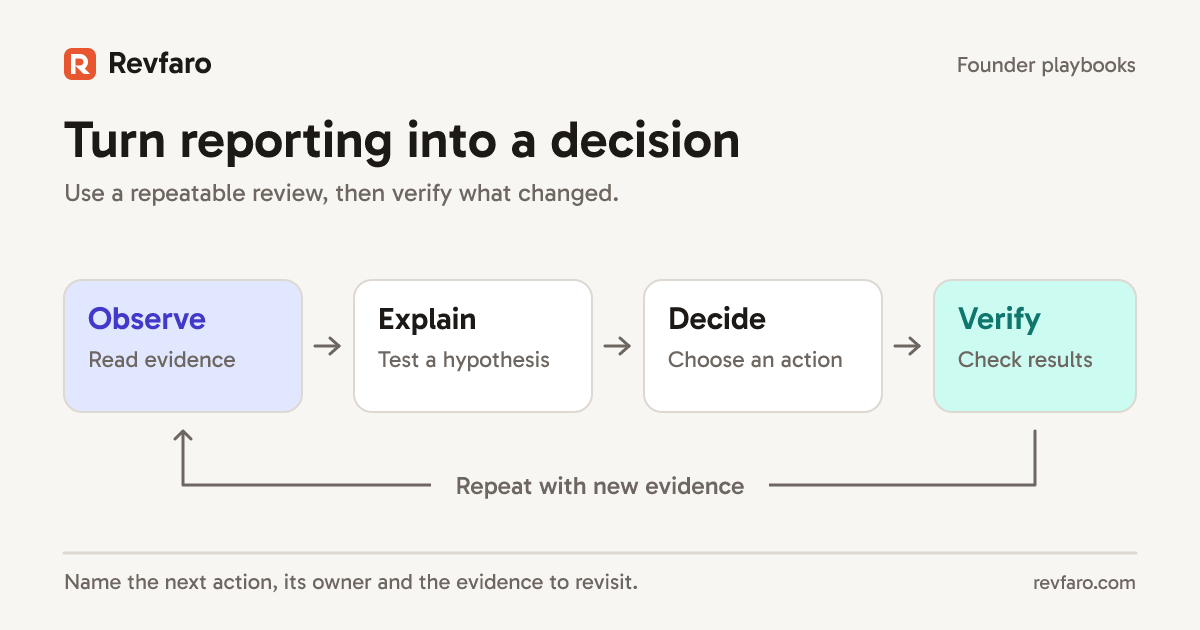
Use a concise founder KPI report each week and a deeper cohort and channel review monthly. Set specific hypotheses such as improving trial activation in one segment or shortening checkout friction. Avoid installing an elaborate analytics stack unless a concrete analysis requires it.
Reconcile a monthly movement bridge
Use an illustrative recurring-value worksheet: opening MRR of $2,000, new MRR of $300, expansion of $100, contraction of $50 and churned MRR of $200 produce closing MRR of $2,150. Keep the underlying subscription changes accessible so the bridge can be checked instead of merely copied into a slide.
A refund is a cash adjustment and should not automatically be subtracted again as churned MRR. Determine whether the recurring subscription value changed under your documented definition. Likewise, an annual payment needs normalization for the recurring worksheet even though its cash receipt is a different amount.
These are separate business calculations, not native Revfaro MRR, retention or LTV features. Use supported payment records and goal outcomes as evidence in the acquisition review, then reconcile recurring movements with the provider. Keep the scope and maturity of customer cohorts visible before treating a channel's early payback or retention as stable.
Related reading
- SaaS Metrics from Zero to $1K MRR: A Founder Playbook
- A 30-Day SaaS Analytics Setup Plan for Founders
- The Weekly SaaS Founder KPI Report: One Page, Better Decisions
Frequently asked questions
Should I prioritize new MRR or churn reduction?
Both matter; decide using cohort evidence, growth efficiency, and the actual size of each opportunity.
Is $10K MRR enough for advanced attribution?
Not by itself. Data volume, buying cycle, channels, and decision needs determine the right complexity.