
Quick answer
GEO measurement evaluates whether a SaaS brand is discoverable and useful in AI-assisted search experiences. There is no universal cross-platform “AI ranking” that website owners can fully observe, so combine available search reporting, referral visits, and real customer outcomes.
Key takeaways
- Label manual answer checks as bounded samples, not universal market share.
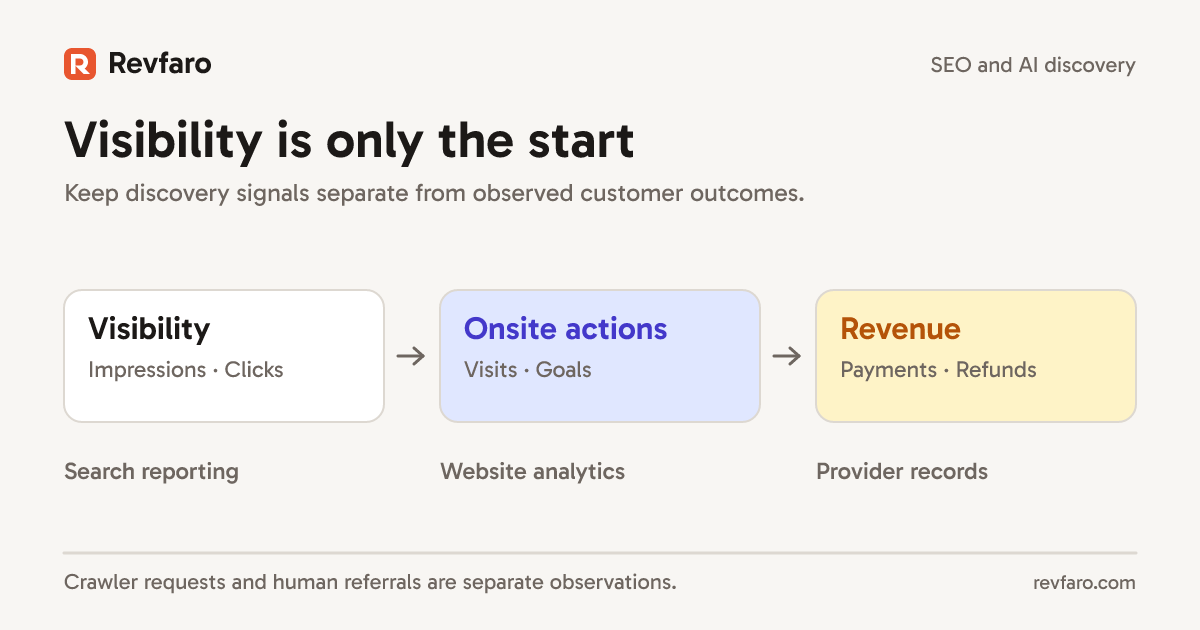
- Separate mentions, referral visits, bot fetches and recorded outcomes.
- Use current platform guidance without promising guaranteed AI inclusion.
Separate visibility from traffic and revenue
A brand may be mentioned in an answer without a click. An assistant may send a visitor without exposing the exact prompt. A crawler may fetch a page without generating either a mention or referral. Track these as different observations.
Use platform-provided reporting where available and disclose what it covers.
Create a defensible measurement framework
For your target buyer questions, maintain a small, documented query set and record visible answers at agreed intervals. Note platform, location, timestamp, and variability. Complement this qualitative observation with AI-associated referral sessions, activation, and verified payment data.
Do not present manually observed mentions as a statistically representative share of all AI answers.
Invest in content with independent value
Publish original definitions, reproducible examples, transparent methodology, and genuinely useful tutorials. Add source links to official documentation when making technical claims. Keep semantic headings and accessible HTML; a table of contents helps readers, but is not a special AI ranking switch.
Google's guidance says its AI search features require no additional technical requirements, special AI markup or separate machine-readable files. Standard technical eligibility and useful content still matter.
Review the commercial outcome
Measure which problem-solving pages attract qualified prospects across search and referrals, not only which brand queries produce a mention. Update stale articles and document what changed.
Official reference
Read Google Search Central's AI optimization guide.
Give a manual observation a bounded label
For a hypothetical monthly review, choose five buyer questions and record the assistant, date, visible response, linked pages and relevant context for each observation. Label the result A small manual sample. Do not call the fraction mentioning your product its share of all AI recommendations; the selected questions and repeated responses are not a representative population.
Keep that worksheet separate from observed website referrals and completed goals. Revfaro can show recorded acquisition evidence and goal outcomes, while bot hits describe a different process. It does not supply a universal AI ranking or automatically collect this manual answer sample.
Use disagreements to improve factual clarity: correct an outdated integration explanation, add a reproducible example or link the relevant setup guide. Follow Google's current AI features guidance for Google-specific eligibility. Helpful structure and crawl access support discoverability, but the resulting page still has no guaranteed citation.
Related reading
- AI Referral Traffic Analytics: ChatGPT, Perplexity, and Beyond
- Branded vs Non-Branded Organic Search for SaaS Growth
- SEO ROI for SaaS: Measure Leads, Activation, and Revenue
Frequently asked questions
Does GEO require an llms.txt file?
Google's guidance says no new machine-readable or AI text files are required to appear in its AI search features. Other services may have their own documentation; a file alone does not guarantee inclusion.
Can a tool guarantee AI citations?
No credible measurement setup can guarantee that an assistant will cite any particular page.