
Quick answer
Ad blockers and browser privacy controls can prevent analytics scripts, requests, or identifiers from functioning. The effect varies by audience and implementation, so reported visits are often an estimate rather than a complete census.
Key takeaways
- Test distinct collection failure modes rather than assuming one blocker effect.
- CDN request counts are not a substitute for human sessions.
- Respect opt-outs across ordinary and first-party collection paths.
Identify the missing-data pathways
A browser may block script loading, reject network requests, delete storage, limit cross-site identifiers, or restrict referrers. A single blocker can affect pageviews, journeys, and campaign attribution differently.
Do not assume a fixed global percentage of missing traffic. Developer audiences, geographic regions, and devices may have different configurations.
Compare independent signals cautiously
Server request logs, CDN request counts, payment records, and browser analytics can help identify mismatches, but they count different entities. One person may request many assets or be a bot; one server request is not a verified human visit.
Explain the measurement contract before presenting a discrepancy chart.
Improve reliability ethically
Use lightweight, well-behaved code, accurate event contracts, consent-respecting modes, and confirmed backend business events where appropriate. Avoid invasive fingerprinting or covert collection to defeat explicit user preferences.
Reconcile purchases from payment systems without assuming every sale can be traced back to a browser session.
Make uncertainty part of decisions
Look for directional trends on stable implementations, segment by known acquisition context, and monitor instrumentation changes. If conversion totals are authoritative but visit counts are incomplete, the resulting “conversion rate” may be biased upward.
Test collection modes without inventing a missing-traffic percentage
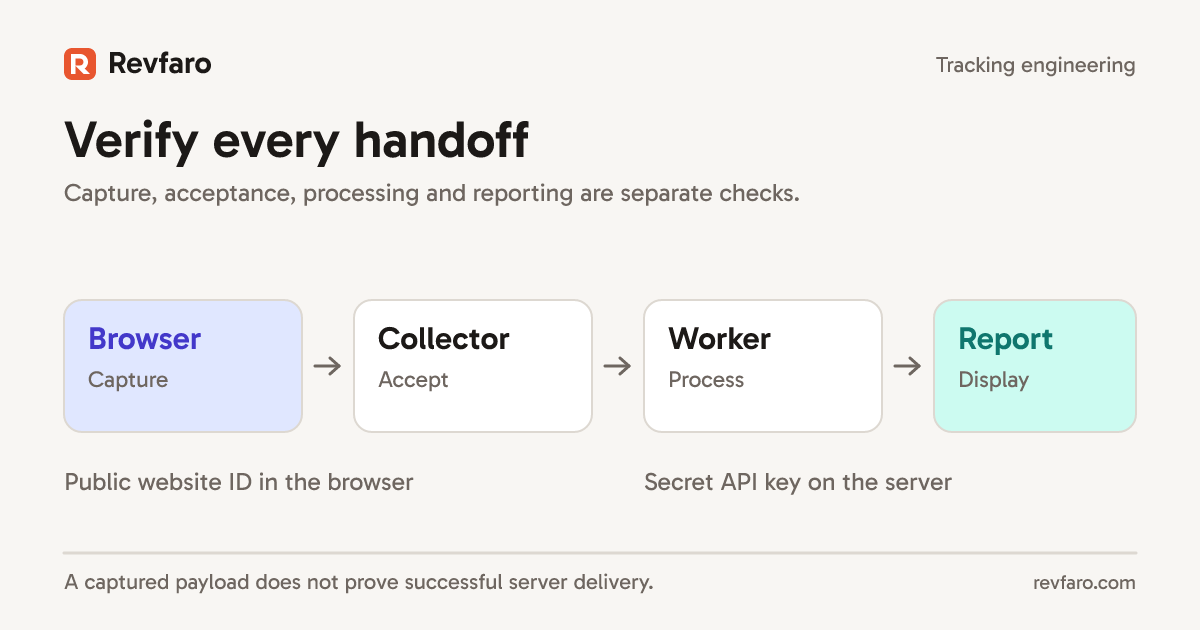
Create a small development matrix with browser configuration, script loaded, request accepted, identifier available and expected report behavior. Run the same public route under the configurations relevant to your audience. Record the observable failure rather than assigning every discrepancy to an ad blocker.
For example, a blocked script and a successful page response explain why a browser event is missing. They do not tell you how many real customers use that configuration. CDN requests also include assets and automated clients, so their total cannot be substituted for human sessions.
When evaluating analytics options through IndieTools, ask each tool the same concrete questions about collection, identity and consent handling. Revfaro documents its SDK behavior, cookieless limits and first-party proxy setup. A proxy is an infrastructure choice, not permission to ignore a person's explicit opt-out. Preserve that choice through every route and collection path.
Related reading
- Analytics Event Deduplication: Stop Double-Counting Conversions
- Cookieless Analytics vs Cookie-Based Tracking: What Changes?
- Stripe Revenue Attribution: A Safe Website-to-Payment Workflow
Frequently asked questions
Do ad blockers make analytics useless?
No. Reliable definitions and honest limitations still support useful decisions, especially when combined with verified product outcomes.
Does server-side tracking reveal every missing visitor?
No. It has its own limitations and must respect applicable privacy and consent requirements.