
Quick answer
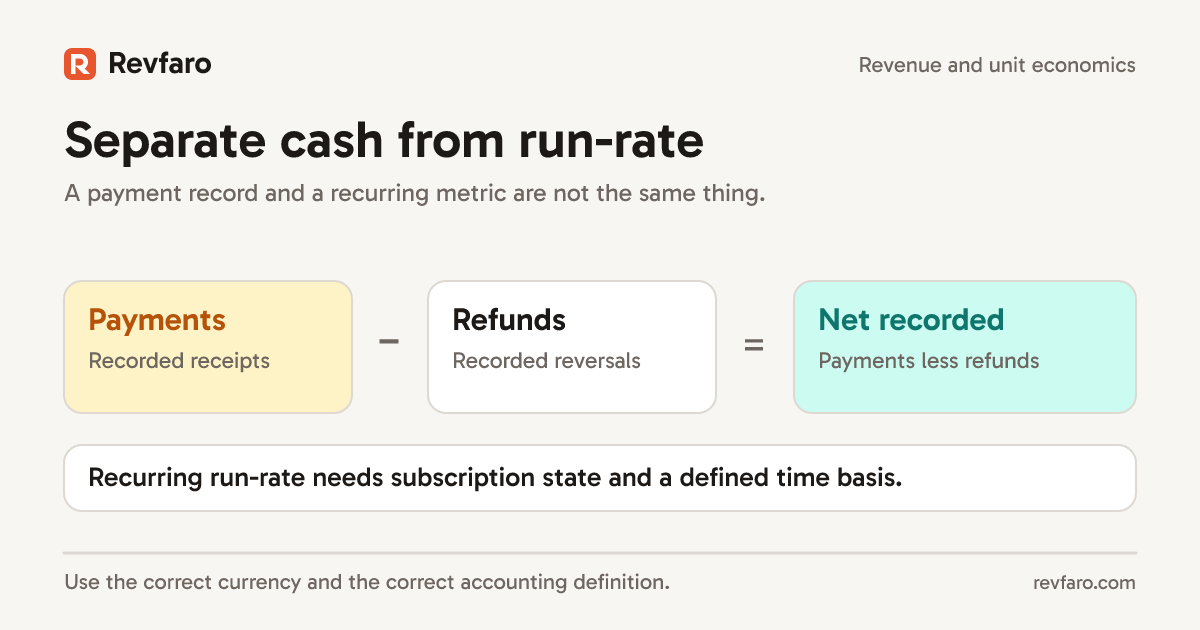
MRR is normalized recurring revenue per month; ARR is its annualized counterpart under a consistent subscription definition. Neither is identical to cash received, profit, or all payments processed during a month.
Key takeaways
- Annual payment cash and monthly recurring run-rate are different quantities.
- Exclude one-time charges from a recurring metric under the stated definition.
- Revfaro payment totals are not automatic MRR or ARR calculations.
Normalize billing cadence
A $20 monthly subscription typically contributes $20 MRR. A $240 annual subscription can contribute $20 normalized MRR, even if the full $240 is collected upfront. ARR in that simple model is MRR × 12.
Define what counts as recurring: live subscription fees generally do, while one-time setup fees and unrelated transaction volume do not. Be consistent about taxes, discounts, usage charges, and currency handling.
Separate revenue movements
Track new MRR, expansion, contraction, churned MRR, and reactivation. Net new MRR is new plus expansion plus reactivation minus contraction and churn. A high number of new subscriptions can hide poor existing-customer retention.
For a refund or failed renewal, decide whether the change belongs in recurring run-rate reporting, cash-flow reporting, or both, and document that distinction.
Example: cash can be misleading
Suppose ten customers pay $120 each for annual plans in one month. Cash collected is $1,200 before fees and other adjustments. Under simple straight normalization, recurring run rate contributed is $100 MRR and $1,200 ARR—not $1,200 MRR.
Changing this definition during growth makes graphs incomparable. Store original billing terms and normalized values separately.
Use MRR in decisions, not vanity comparisons
Pair it with churn, net revenue retention, and customer counts. For a business selling one-time licenses, MRR may not be the right main metric at all.
Keep a normalization ledger beside receipts
Use this hypothetical subscription ledger, excluding taxes and one-time charges for the exercise:
| Contract | Amount charged at renewal | Cadence | Normalized monthly amount |
|---|---|---|---|
| Account A | $20 | Monthly | $20 |
| Account B | $240 | Annual | $20 |
| One-time setup | $60 | Once | $0 recurring |
If all three charges arrive this month, receipts total $320 while the simplified recurring run-rate is $40 MRR. The ledger preserves both answers rather than dividing all payments by twelve.
Stripe Billing analytics documents its own metric definitions and configurable treatment of some inputs. Align your definition before comparing reports. Revfaro's revenue chart records supported payments and refunds; it does not automatically normalize your subscription contracts into MRR or ARR. Use the provider's subscription records or a separately maintained calculation for recurring metrics, and keep accounting recognition distinct from these operational run-rate measures.
Related reading
- SaaS Revenue Attribution: Connect Marketing Traffic to Real Payments
- ARPU vs ARPA in SaaS: Revenue per User or Account?
Frequently asked questions
Is ARR always exactly twelve times MRR?
In a consistent annualized run-rate convention, often yes. Actual recognized accounting revenue and forecasting may differ.
Does a one-time purchase contribute to MRR?
Normally no. It is revenue, but not contractually recurring revenue.