
Quick answer
SaaS revenue attribution connects observed acquisition touchpoints to payment transactions under a documented credit rule. Good implementation starts with verified provider events, stable transaction IDs, explicit identity links, and an honest unattributed category.
Key takeaways
- Verify the transaction and the visitor association separately.
- Inspect the matching method instead of assuming all attribution is equally certain.
- Revfaro reports last non-direct attribution without automatic currency conversion.
Keep payments separate from page events
A checkout success redirect is a browser interaction; a confirmed payment is a financial event. Use payment-provider webhooks or another authoritative reconciliation source to establish amount, currency, status, refunds, and transaction identity. Verify signatures and deduplicate retries before updating revenue totals.
Keep Revfaro subscription billing conceptually distinct from any customer's own payment-provider integration. A reporting product should not blend its own SaaS receipts with the customer's revenue.
Build evidence-based links
Capture eligible source and campaign information during the visit. If a customer later checks out, pass an allowed, non-sensitive correlation identifier through the approved checkout metadata or authenticated account relationship. Use documented priority rules to resolve multiple possible matches.
If a payment has no defensible link, leave it unattributed. Do not silently classify every unknown transaction as direct or organic.
Choose and disclose a model
Under last non-direct touch, an organic discovery may receive credit when the buyer returns directly. Under last touch, the direct return may receive credit. Both are policies, not proof that a channel caused the purchase.
Use a fixed lookback period, account for cross-device gaps, and show the percentage of revenue successfully matched.
Reconcile the commercial numbers
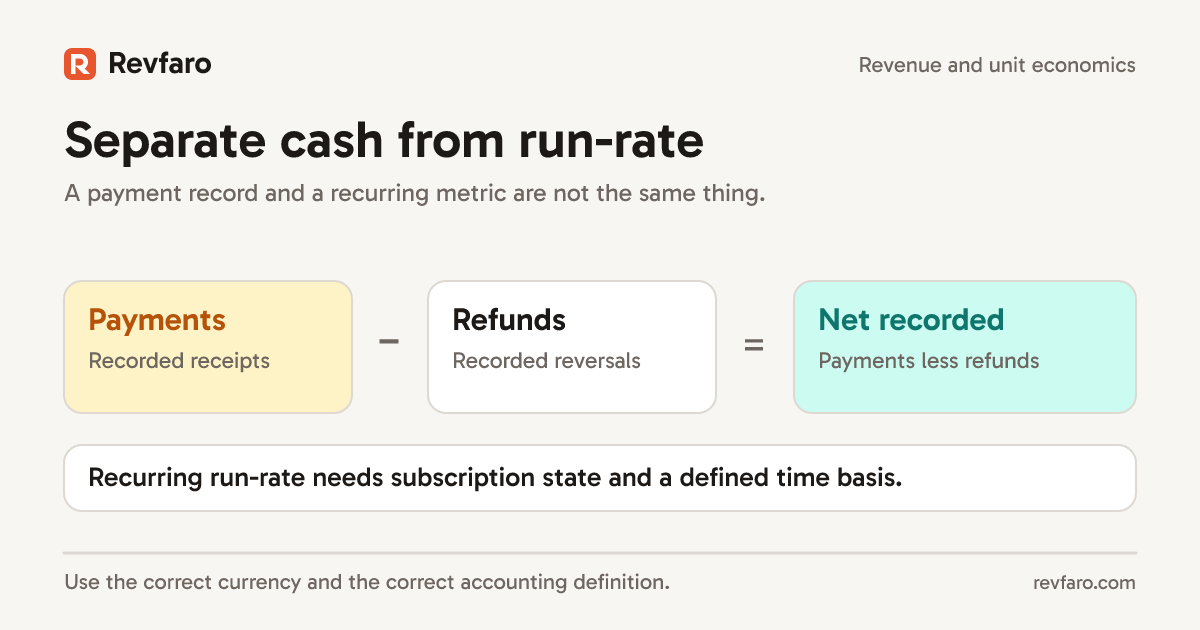
Track initial payments, renewals, refunds, discounts, tax treatment, and currencies explicitly. Do not sum unrelated currencies without a defined conversion policy. A channel report should reconcile to the underlying verified payment ledger before influencing spend.
Audit one payment through the complete chain
Use an illustrative $49 purchase to define the evidence you expect: the eligible visit, a trusted visitor/session pair at checkout, the verified provider payment and the matching result shown in analytics. Keep the provider reference, amount and currency together. A payment can be financially valid while its marketing source remains unknown.
Revfaro uses last non-direct touch. Its matching methods are displayed in Journey, so an explicit visitor association and a fallback association should not be presented as identical evidence. Renewals retain their original association; recorded refunds reduce revenue. Foreign-currency rows remain in history but are excluded from totals in another reporting currency, unless a supported settlement amount matches that currency.
For a concrete integration pattern, IndieTools uses the Revfaro SDK for website activity and a separate server connection for payment notifications. This describes an implementation, not a claim about its customers' conversion results. Keep the same separation in your application: browser behavior supplies context, while the provider establishes the payment.
Related reading
- Refunds, Chargebacks, and Net Revenue in SaaS Attribution
- MRR vs ARR: SaaS Revenue Metrics Founders Must Not Mix
Frequently asked questions
Does a webhook identify the marketing source?
Usually not by itself. It verifies a payment; attribution requires an additional trustworthy link to the customer journey.
Should unattributed revenue be hidden?
No. Its size is an important measure of attribution completeness and uncertainty.