
Quick answer
Customer churn measures the share of starting customers who leave during a period. Revenue churn measures recurring revenue lost through cancellations or contraction. These answer different questions and must not use new customers to dilute the starting denominator.
Key takeaways
- Define the effective churn event and date before counting losses.
- Keep the opening cohort fixed when new customers arrive.
- A missing recent payment alone does not establish churn.
Calculate customer churn
Start with the number of eligible paying customers at period opening. Count how many of those customers became churned according to your policy. If 100 started the month and five left, monthly logo churn is 5%.
Define what “left” means: cancellation request, subscription expiration, failure to recover payment, or end of paid access. These dates may differ.
Separate gross and net revenue churn
Gross revenue churn reflects lost and contracted recurring revenue, divided by starting recurring revenue. Net revenue churn offsets those losses with expansion from existing customers. New customer MRR should not be used to hide churn from the opening cohort.
Suppose a $10,000 opening MRR base loses $500 to cancellations, $200 to downgrade, and gains $300 from expansion. Gross revenue churn is 7%; net revenue churn is 4%.
Avoid cohort contamination
Do not include trials, expired test subscriptions, or brand-new signups in the opening paid cohort unless your metric explicitly calls for them. Segment by plan, customer age, and acquisition source so one large account does not conceal patterns in smaller customers.
Keep churn reasons as qualitative context, not as perfect causal data.
Use churn to prioritize work
If customers churn before reaching first value, improve onboarding. If mature users leave after price changes, investigate feature fit and perceived value. Do not conclude that marketing is responsible without examining the product experience.
Choose the event that ends an account's membership in the cohort
Imagine an account requests cancellation on November 8 but retains paid access until November 30. A cancellation-request metric and an end-of-paid-access churn metric will record different dates. Keep the chosen rule in the report rather than treating either timestamp as universally correct.
For the opening cohort of 100 accounts, retain a fixed list of account IDs and classify each account at the evaluation date. Ten newly acquired accounts do not become part of that opening population. A failed payment that is later recovered also needs an explicit treatment rather than an ad hoc correction to make the rate look better.
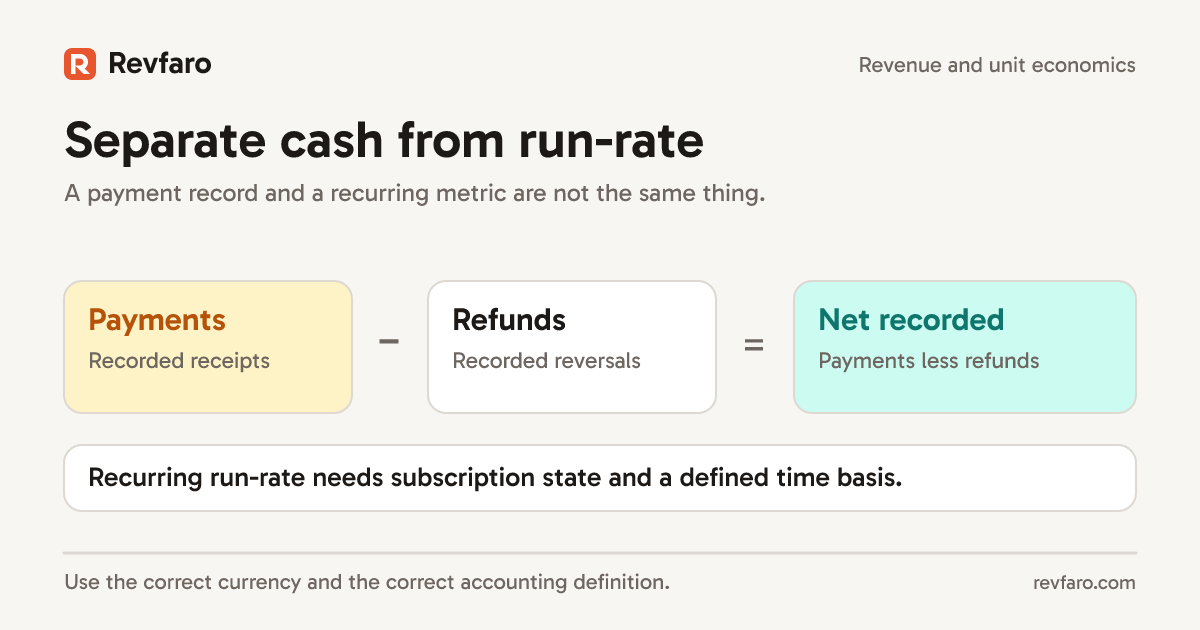
Record a compact audit trail: opening status, qualifying change, effective date and reason category. Use subscription records for this analysis. Revfaro's payment history and attribution provide observed receipts and source context, but a missing payment in a short dashboard period is not proof that an account churned.
Related reading
- ARPU vs ARPA in SaaS: Revenue per User or Account?
- Net Revenue Retention Explained for SaaS Founders
- SaaS Revenue Attribution: Connect Marketing Traffic to Real Payments
Frequently asked questions
Can customer churn and revenue churn move in opposite directions?
Yes. Losing small accounts while expanding large ones may worsen logo churn while improving net revenue retention.
Should involuntary payment failures count?
Track them explicitly and report your chosen churn definition; payment recovery and voluntary cancellation warrant different actions.