
Quick answer
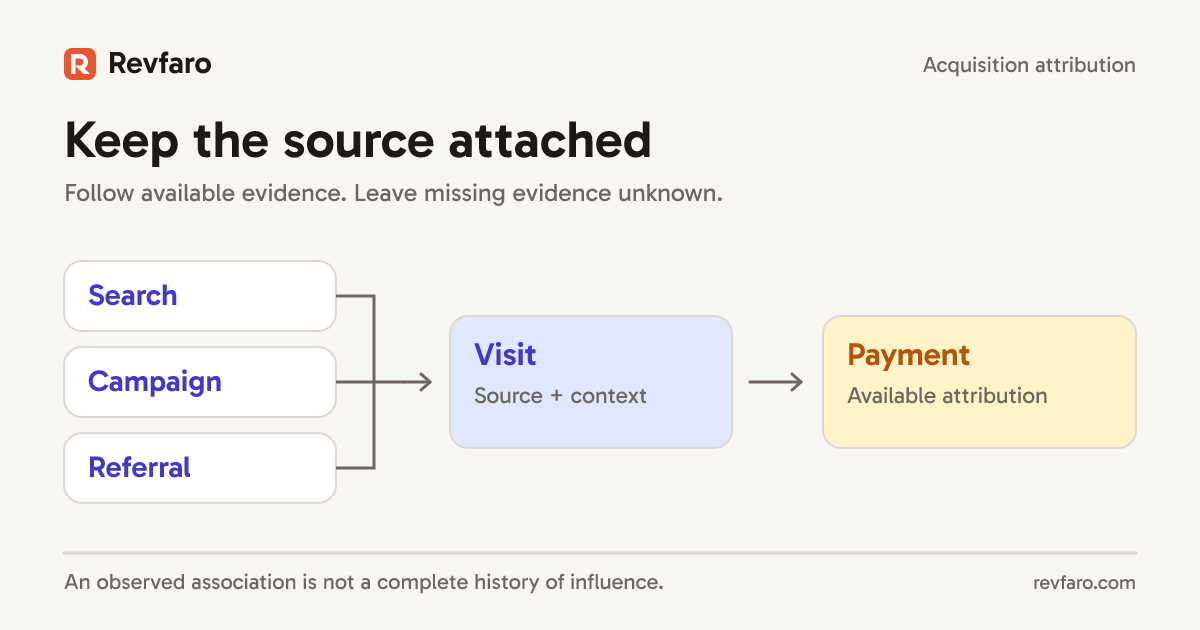
Referral attribution connects a partner or referring website to a later conversion using declared identifiers and a consistent credit rule. It should distinguish recorded referrers, tagged partner campaigns, and payout-eligible referrals.
Key takeaways
- Referrer evidence, campaign labels and commission eligibility are separate records.
- Browser policies can reduce a referrer to its origin.
- Keep financial payout rules outside a generic analytics classification.
Separate the three kinds of referral
A browser referrer may identify the referring origin or page, depending on the browser and referrer policy. A UTM-tagged campaign tells you which link you controlled. An affiliate program may assign an explicit referral code with contractual eligibility rules. These are related signals, not identical records.
Document whether your analytics model uses first touch, last touch, last non-direct touch, or another rule. Affiliate commission decisions should follow the affiliate agreement and fraud checks, not an arbitrary dashboard default.
Build a resilient partner link
Give each partner a stable campaign identity and require a consistent medium. Test that redirects preserve campaign data. Define the attribution window and which event constitutes a conversion. Use a verified server-side purchase or subscription event for commercial credit.
Keep the partner ID separate from customer PII. Do not put private customer details in URLs.
Handle ambiguous journeys honestly
Imagine a visitor comes from Partner A, returns via organic search, and pays on another device. You may have evidence for the initial referral but not a reliable link to payment. Report the purchase as unattributed if your rules and evidence cannot join it.
Store the observed path where lawful and keep model-based credit visibly distinct from contractual affiliate payouts.
Review referral quality
Compare partner cohorts on activation, paid conversion, refund rates, and retention. A partner generating many coupon clicks may be less valuable than a smaller, highly relevant integration guide.
Maintain three separate referral records
For an illustrative partner campaign, keep an acquisition record, a payment record and a commission decision. The acquisition record says a visitor arrived through a tagged partner link. The payment record says the provider confirmed a transaction. The commission decision applies the actual partner agreement, including exclusions or refund handling. A single analytics label cannot replace all three.
A product listing on IndieTools can be one source in that acquisition register. Preserve the listing URL and the campaign definition, then compare recorded visitors and successful outcomes over the same period. The presence of a directory link does not guarantee traffic, sales or search ranking.
Revfaro's revenue matching rules explain which evidence it uses to associate a payment with a visitor. Review the displayed matching method before using an association as supporting evidence. Keep contractual payout logic in your affiliate or billing system rather than silently treating last non-direct analytics credit as a commission instruction.
Related reading
- Organic vs Paid Traffic: Which Produces Better SaaS Customers?
- How to Measure SEO Signups and Revenue Beyond Organic Clicks
- UTM Parameters Explained: A Clean Tracking System for SaaS
Frequently asked questions
Is a referrer header enough for affiliate payouts?
Usually not. An affiliate program needs explicit terms, identity rules, fraud controls, and verified outcomes.
Why do referral sources disappear?
Privacy restrictions, redirects, browser policies, direct return visits, and cross-device behavior can remove or break the signal.