
Quick answer
Customer lifetime value (LTV) estimates the contribution a customer generates across the relationship. A simple subscription approximation is monthly gross profit per customer divided by monthly customer churn, but its assumptions often break in early SaaS businesses.
Key takeaways
- Small changes in assumed churn can produce large changes in estimated value.
- Separate observed contribution from modeled future amounts.
- Do not present a simple steady-state approximation as a forecast guarantee.
Start with contribution, not gross receipts
Revenue alone ignores delivery costs. An LTV useful for acquisition decisions should consider gross margin and consistent customer-level definitions. If customers pay different amounts or expand over time, cohort analysis can be more informative than an average.
Do not mix annual churn with monthly ARPA without converting the units correctly.
Use the shortcut cautiously
Assume monthly revenue per account is $40, gross margin is 80%, and steady monthly customer churn is 4%. Monthly gross profit per account is $32; the simple steady-state approximation gives $32/0.04 = $800.
This is not a forecast guarantee. It assumes roughly stable churn and margin and ignores discounting, expansion, cohort heterogeneity, and uncertain future behavior.
Prefer observed cohorts as data matures
Track revenue and gross profit by acquisition month and retention age. Sum realized contribution to date, then model future periods separately with visible assumptions. Newer cohorts have less follow-up and should not be treated as inherently worse.
When sample size is small, present a range or scenario analysis instead of a single authoritative LTV number.
Use LTV for pricing and acquisition limits
Compare estimated customer value with CAC and payback period. A healthy-looking ratio can still strain cash if acquisition spending is immediate and customer payments arrive slowly.
Expose the churn assumption with a sensitivity table
Using the hypothetical $32 monthly gross profit per account, keep the steady-state assumption visible:
| Assumed monthly customer churn | Simplified value estimate |
|---|---|
| 2% | $1,600.00 |
| 4% | $800.00 |
| 6% | $533.33 |
This table changes only one assumption. It is not a prediction interval, and the three rows are not equally likely merely because they appear together. A business with little history cannot turn an assumed two-percent rate into evidence of a long customer lifetime.
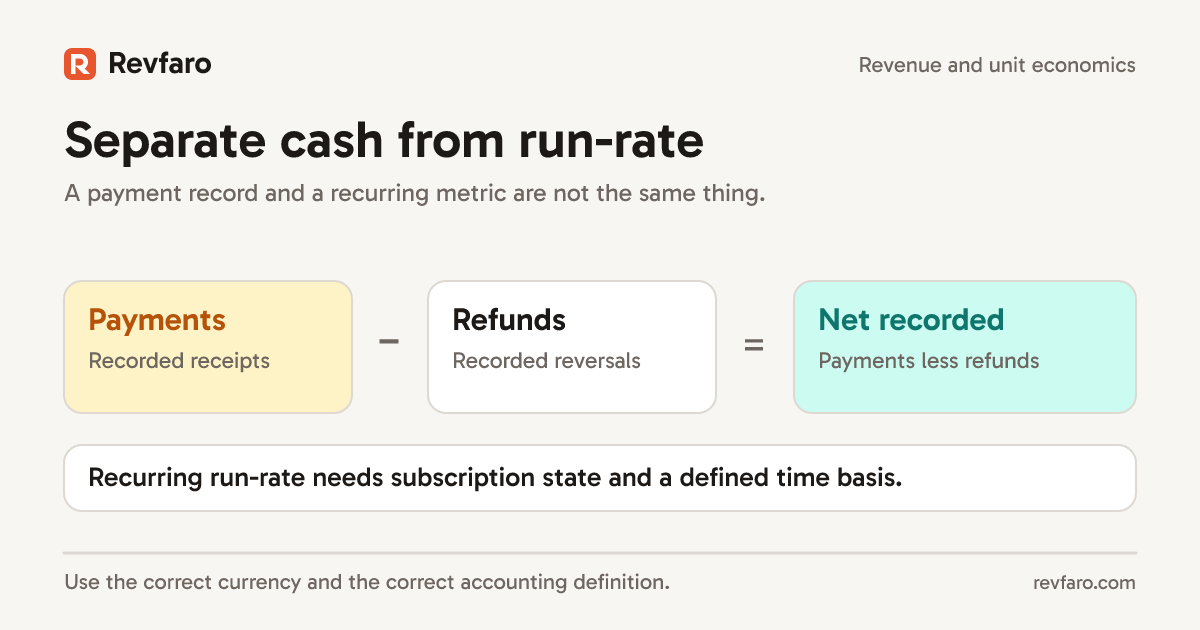
Separate realized contribution to date from modeled future contribution. Record how delivery costs, refunds and customer expansion enter the calculation. Stripe's overview of lifetime value describes multiple approaches; choose and label the one answering your question. Revfaro's recorded revenue provides observed transaction context, not a guaranteed lifetime forecast or a complete gross-margin ledger.
Related reading
- Net Revenue Retention Explained for SaaS Founders
- Customer Acquisition Cost for SaaS: Calculate CAC by Channel
- SaaS Revenue Attribution: Connect Marketing Traffic to Real Payments
Frequently asked questions
Is LTV the same as total revenue per customer?
Not necessarily. Decision-oriented LTV often considers margin, retention, and expected future contribution.
Can a new SaaS calculate reliable LTV?
It can build scenarios, but reliable long-term estimates usually require mature retention cohorts.