
Quick answer
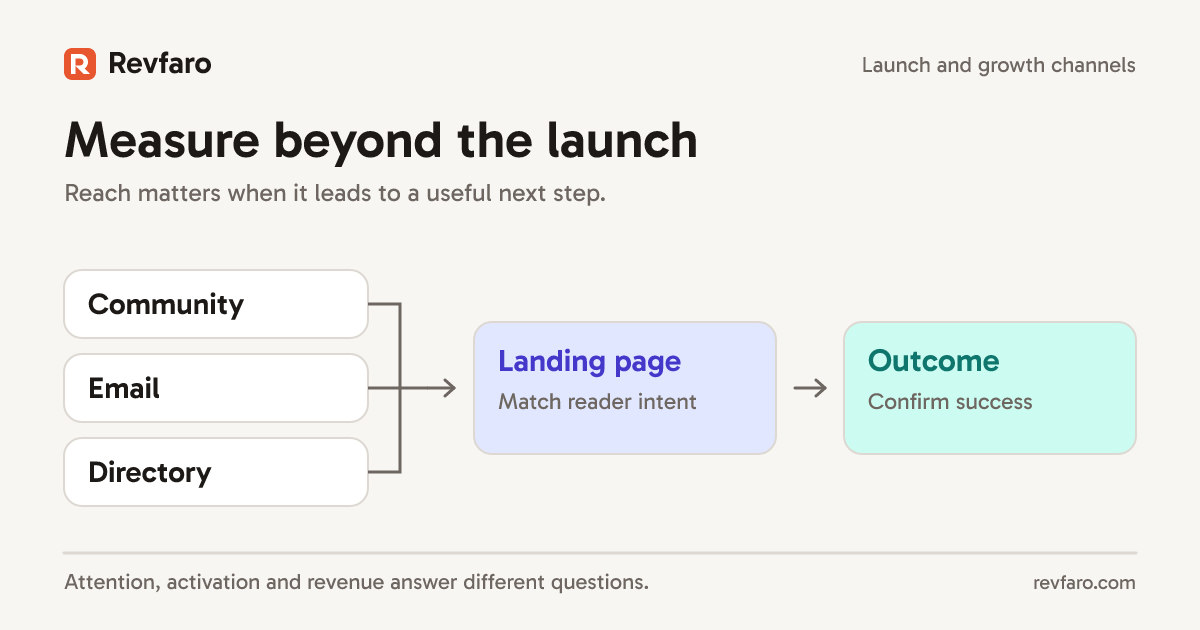
Community-led growth happens when useful participation, relationships, and user advocacy help people discover and adopt a product. Its measurement requires patience: private recommendations and delayed purchases are not always directly attributable.
Key takeaways
- Separate qualitative contribution evidence from measured conversions.
- Keep self-reported and browser-derived sources distinct.
- Use bounded follow-up decisions rather than indiscriminate promotion.
Define community value first
Choose communities where your experience solves real member questions. Track substantive contributions and resulting product feedback, not just the number of links posted. Participation that improves documentation can have value even without direct sales.
Respect moderation rules and avoid manipulating discussion or voting.
Combine quantitative and qualitative signals
Where links are allowed, tag controlled resource links consistently. Track meaningful site behavior and onboarding completion. Add optional customer-source feedback to capture recommendations that arrive through private messages and untagged conversations.
Treat self-reported origins and browser referrers as different evidence types.
Build a sensible review
Over a month, note recurring user problems, useful guides created, qualified signup cohorts, and activated customers. Record founder time invested. A community with thirty high-intent visitors can be more valuable than one that sends a thousand curious readers.
Do not claim all revenue from a period belongs to the most active community.
Improve through feedback
Use questions to prioritize product fixes and publish honest educational resources. Revisit contribution quality and customer retention instead of measuring only promotional reach.
Review contributions as a small portfolio
Keep a four-column monthly record: reader problem, contribution made, observed response and follow-up decision. An illustrative entry might be “installation confusion; published a troubleshooting answer; three useful questions; improve the setup guide.” Those questions are qualitative evidence, not three acquired customers.
When an allowed link produces visits, record the campaign and relevant goal separately. If a customer voluntarily reports a community as their origin, preserve that statement as self-reported evidence rather than overwriting the browser's source record. The two can disagree without either being fabricated.
Use campaign links only where permitted and keep private messages and member identities out of routine analytics properties. Review the quality of the contribution even when attribution is incomplete. A useful decision might be to repair documentation, stop an irrelevant channel or spend another bounded hour answering a recurring question; it does not need a claimed revenue total for every conversation.
Related reading
- X and Twitter Traffic Analytics for Indie SaaS Launches
- Affiliate Marketing Analytics for SaaS: Beyond Referral Clicks
- Product Hunt Launch Analytics: Measure More Than Upvotes
Frequently asked questions
Is community-led growth impossible to attribute?
Not impossible, but measurement is incomplete. Tagged links and voluntary feedback provide partial evidence.
Should I prioritize communities with the most members?
Not necessarily. Relevance, trust, and user problems matter more than raw size.