
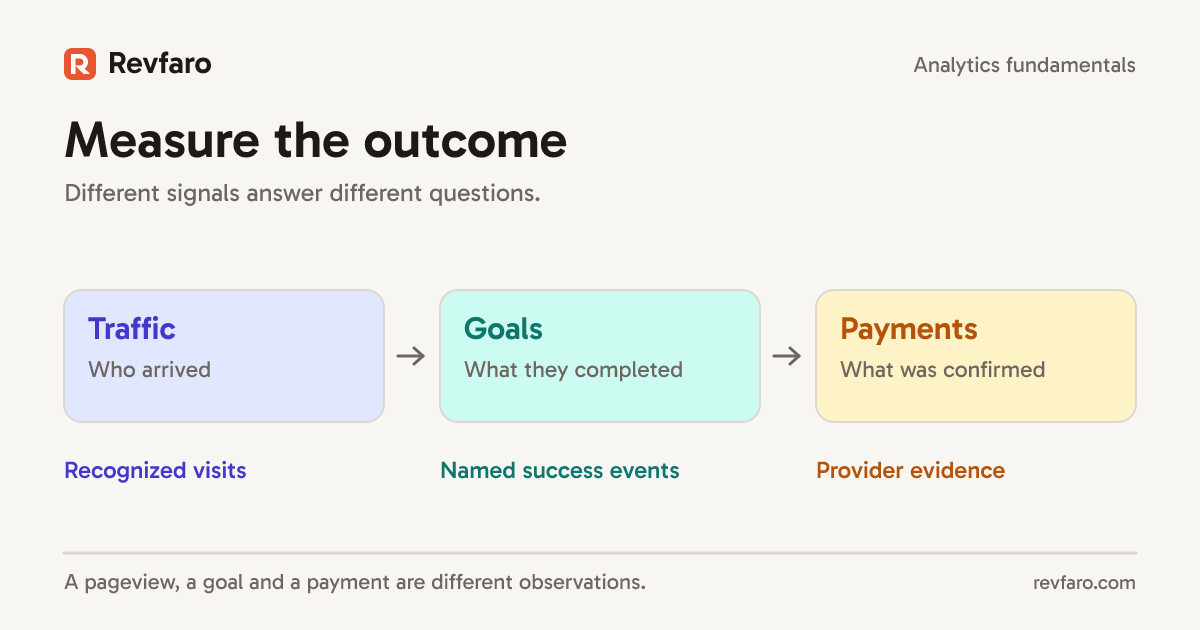
Quick answer
Micro-conversions are actions preceding a primary outcome such as a paid subscription. Examples include viewing pricing, starting a trial, reaching an onboarding milestone, or opening checkout. They are useful signals, not revenue substitutes.
Key takeaways
- Click goals measure attempts unless the success condition is explicit.
- Emit completion only after the product confirms it.
- Judge micro-conversions against downstream outcomes.
Choose actions that reveal progression
A scroll or hover is easy to record, but it may not indicate intent. Stronger candidates are behaviorally closer to value: a pricing-page view after feature exploration, a completed integration setup, or a trial workspace collecting its first meaningful event.
Write one hypothesis per micro-conversion: “Users who complete X are more likely to reach Y.” Verify that relationship with cohort data instead of assuming it.
Instrument events once
Use descriptive event names such as trial_started, integration_connected, and checkout_initiated. Define “completed” precisely. Do not fire the same success event from both a button click and the resulting confirmation page unless you distinguish attempt from completion.
Add safe attributes when useful, such as product tier or campaign. Never send passwords, payment card data, access tokens, or sensitive form contents to analytics.
Evaluate predictive value, not volume
Suppose 400 visitors view pricing and twenty purchase, while 100 visitors complete a core setup step and twenty-five purchase. These populations may overlap; neither percentage proves causation. Still, the setup action may be a useful candidate for activation analysis.
Compare time-based cohorts to avoid comparing old customers with new trials. Keep the primary commercial conversion clearly labeled.
Remove noisy tracking
Review event definitions each quarter. If nobody uses a click metric for decisions and it does not describe meaningful behavior, retire it. More instrumentation increases debugging, storage, consent, and interpretation work without automatically increasing insight.
Separate an attempt from a successful outcome
Consider an illustrative import flow. A person clicks Import three times because validation keeps failing, then corrects the file and succeeds once. Recording every click as import_completed would create three false successes before the real one.
Use distinct contracts:
| Goal | Trigger | What it does not establish |
|---|---|---|
import_started |
The person starts the import flow | A valid file or finished task |
import_completed |
The application confirms successful processing | A paid purchase |
checkout_opened |
Checkout navigation starts | Collected revenue |
With Revfaro, a data-rf-goal attribute is suitable for a click goal. For a completion event, emit the goal from the confirmed success path using the script or SDK interface. Do not attach both mechanisms to the same event. Verify one attempt and one success in an isolated test setup, then inspect real results over a suitable period. Nothing appearing in Goals means no matching recorded goal, not that the platform should manufacture a conversion.
Related reading
- The Essential SaaS Analytics Dashboard: 12 Metrics Worth Reviewing
- Realtime Website Analytics: When Live Data Is Actually Useful
- Website Analytics for SaaS Founders: What to Measure First
Frequently asked questions
Is a pricing-page view a conversion?
It can be a micro-conversion but is not a purchase. Label it as an intent event.
How many micro-conversions should I start with?
Three to five high-intent events are sufficient for many early products. Expand when a specific decision needs another signal.