
Quick answer
Website analytics for a SaaS founder should connect visits to meaningful actions, not stop at a traffic chart. Start with acquisition source, landing page, sign-up, activation, and paid conversion. Add revenue attribution once the underlying events are reliable.
Key takeaways
- Define successful outcomes before choosing charts.
- Keep browser intent and verified payments separate.
- Compare channel quality using consistent units and complete periods.
Start with a business question, not a dashboard
The useful question is not simply whether visits increased. It is whether a particular group of visitors was more likely to become an activated user or paying customer. A technical article may deliver fewer sessions than a broad social post while producing more trial starts. Without acquisition and conversion data, that difference disappears.
Define one decision for each weekly review: which page needs improvement, which channel deserves attention, or where onboarding loses qualified users. A metric belongs on your dashboard when it helps answer a decision.
Build a small measurement model
Track five layers: acquisition (source and campaign), interest (landing pages and engaged visits), intent (pricing views or demo requests), activation (the first product action demonstrating value), and commercial outcome (verified purchases or subscription starts). Describe each event before implementing it, including when it fires and whether it may occur repeatedly.
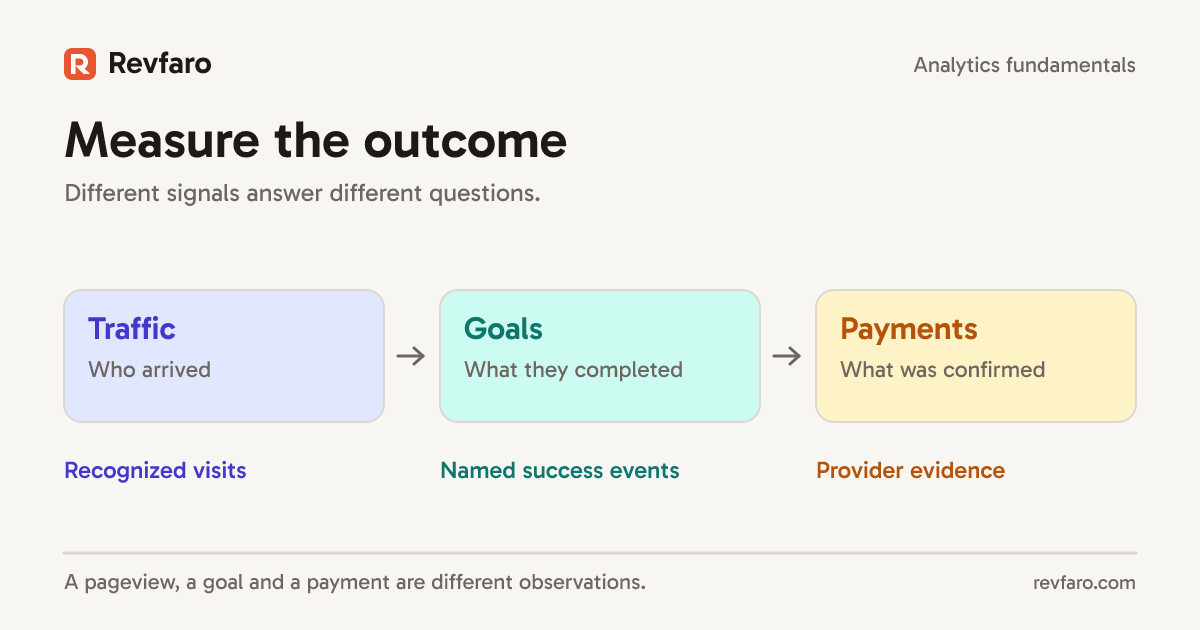
Keep visitors, sessions, events, and customers distinct. One visitor can create many sessions; one customer can make several payments. Mixing those units makes conversion rates misleading.
Work through a realistic example
Suppose two campaigns each send 500 sessions. Campaign A creates 60 sign-ups and six paid customers. Campaign B creates 30 sign-ups and twelve paid customers. A wins on sign-up rate (12% versus 6%), but B wins on paid conversion per session (2.4% versus 1.2%). Which is better depends on cost, retention, and revenue—not the largest visitor count.
This is an illustrative example, not a customer benchmark. Use one attribution policy consistently and allow unattributed purchases instead of guessing a source.
Avoid three misleading shortcuts
Do not interpret a pageview as a person, treat direct traffic as proof of brand demand, or infer revenue solely from a checkout success page. Payment confirmation should come from the provider where possible. Segment bot traffic, and review sampling and consent limitations before comparing channels.
Build a five-event measurement contract
Use this illustrative specification before opening a dashboard. The success condition matters more than the name.
| Observation | When it becomes true | Evidence to keep |
|---|---|---|
| Landing page | The intended public route is displayed | Route and campaign, without private query values |
| Signup started | The person opens the signup form | A browser goal, counted as intent |
| Signup completed | Account creation succeeds | A separate success goal |
| First value | The product finishes its core task | A deliberately instrumented activation goal |
| Payment | The provider confirms a successful transaction | Provider reference, currency and recorded amount |
In Revfaro, start with installation verification, then add the success goals described in goal tracking. The tracker cannot infer your product's activation milestone from a generic button. Revenue needs its own payment connection.
Make the first weekly question narrow: which recorded acquisition source brought people who reached the success goal? Check the underlying counts before interpreting a percentage. A missing payment association should remain visible, even if it makes the chart less tidy.
Related reading
- The 30-Minute Website Analytics Audit for New SaaS Products
- Visitors vs Sessions vs Pageviews vs Events: A Practical Analytics Guide
Frequently asked questions
What is the first analytics metric a SaaS founder needs?
Start with a conversion tied to product value, such as completed activation, and measure it alongside visits and sign-ups. This creates a simple acquisition-to-value view.
Can website analytics show which channel caused a sale?
It can estimate attribution when acquisition and payment events can be connected. It cannot always prove causation, especially across devices, consent choices, and long buying journeys.