
Quick answer
Visitor journey analytics connects a sequence of observed interactions—source, pages, goals, signup, activation, purchase—within the limits of consent and identity resolution. Its purpose is to expose friction and patterns, not reconstruct every individual's private life.
Key takeaways
- Read the observed timeline separately from attribution policy.
- Do not invent links between anonymous activity and purchases.
- Visitor profiles show supported recorded context, not raw IP addresses.
Define the boundaries of a journey
Decide where a journey begins, when it expires, and how anonymous and authenticated events may be linked. Someone who reads on a phone and buys on a laptop may look like two visitors without a permitted identity link.
Make limitations visible. “Unknown” is often more honest than an invented path. Restrict identifiers and prevent sensitive information from entering page URLs or event properties.
Build a useful path model
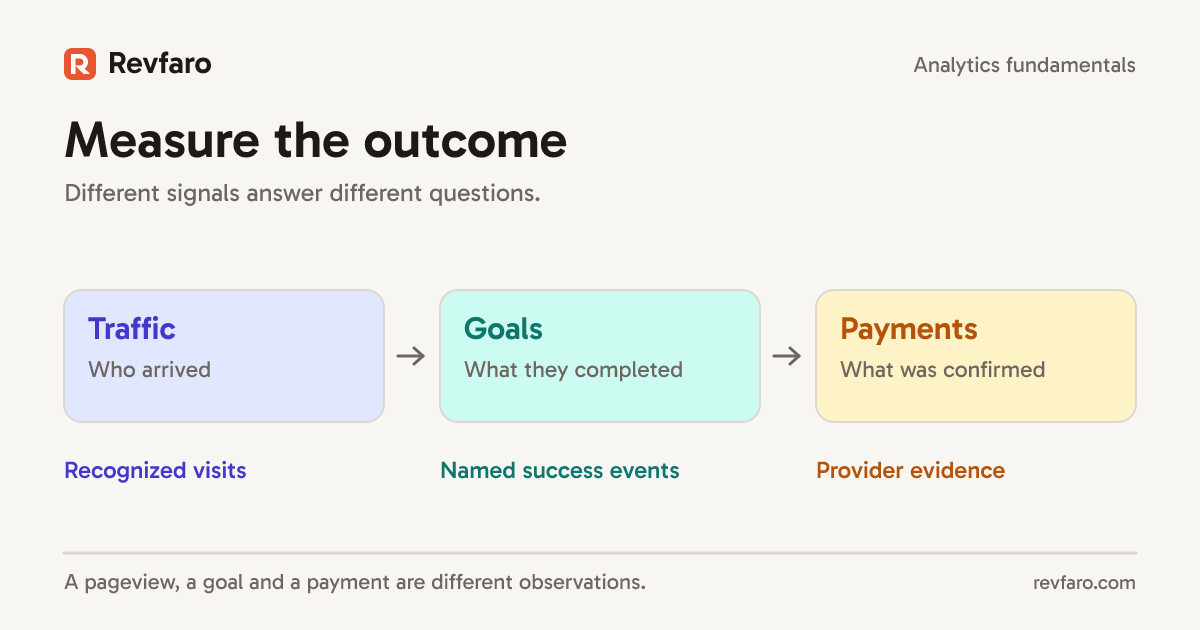
Start with source and entry page. Add high-intent actions, product activation events, and subscription outcomes. Distinguish attempts from successes: checkout_opened is not payment_succeeded, and form_submitted may not mean account_created.
Look for patterns across cohorts rather than overinterpreting one unusual visitor. Segment funnels to find repeatable drop-off by campaign, device, or landing page.
Example: a non-linear customer
A founder discovers a comparison post, returns via a bookmark three days later, begins a trial, and pays after a tagged email. If the email visit is recorded and eligible, both last touch and last non-direct touch can credit that email. If the last recorded visit is direct, the two models can differ. Neither is proof of causation.
Document the attribution rule separately from the observed path, preserving actual events where lawful and possible.
Turn a path into product action
If activated buyers repeatedly consult an integration guide before connecting a provider, surface that guide earlier. If abandoned trials repeatedly hit an error state, fix the blocker before paying for more acquisition.
Read a profile as a partial observation
In Revfaro, open Users and select a visitor to inspect the recorded profile and session timeline. Look for the order of pages, deliberately tracked goals and associated payments. A profile can contain several sessions; filtering the dashboard and inspecting one profile are different tasks.
For an illustrative investigation, write a timeline with four columns: timestamp, observed action, identity evidence and missing information. A row such as “pricing viewed; browser identifier present; no payment association” should remain exactly that. Do not fill the missing payment link with a guess based on a nearby purchase.
An identify call can associate an approved account identifier with activity when implemented appropriately. It does not make all cross-device behavior visible. Revfaro does not retain a visitor's raw IP in the analytics profile. Approximate location, browser and device context support investigation without becoming proof of a person's identity or exact whereabouts.
Related reading
- Landing Pages vs Exit Pages: How to Find Hidden Funnel Leaks
- The 30-Minute Website Analytics Audit for New SaaS Products
- Website Analytics for SaaS Founders: What to Measure First
Frequently asked questions
Can journeys identify users across devices?
Only with a legitimate, reliable link such as an authenticated account identifier, subject to applicable privacy requirements.
Is a journey report an attribution report?
No. A journey shows observed behavior; attribution uses a defined model to allocate credit for an outcome.